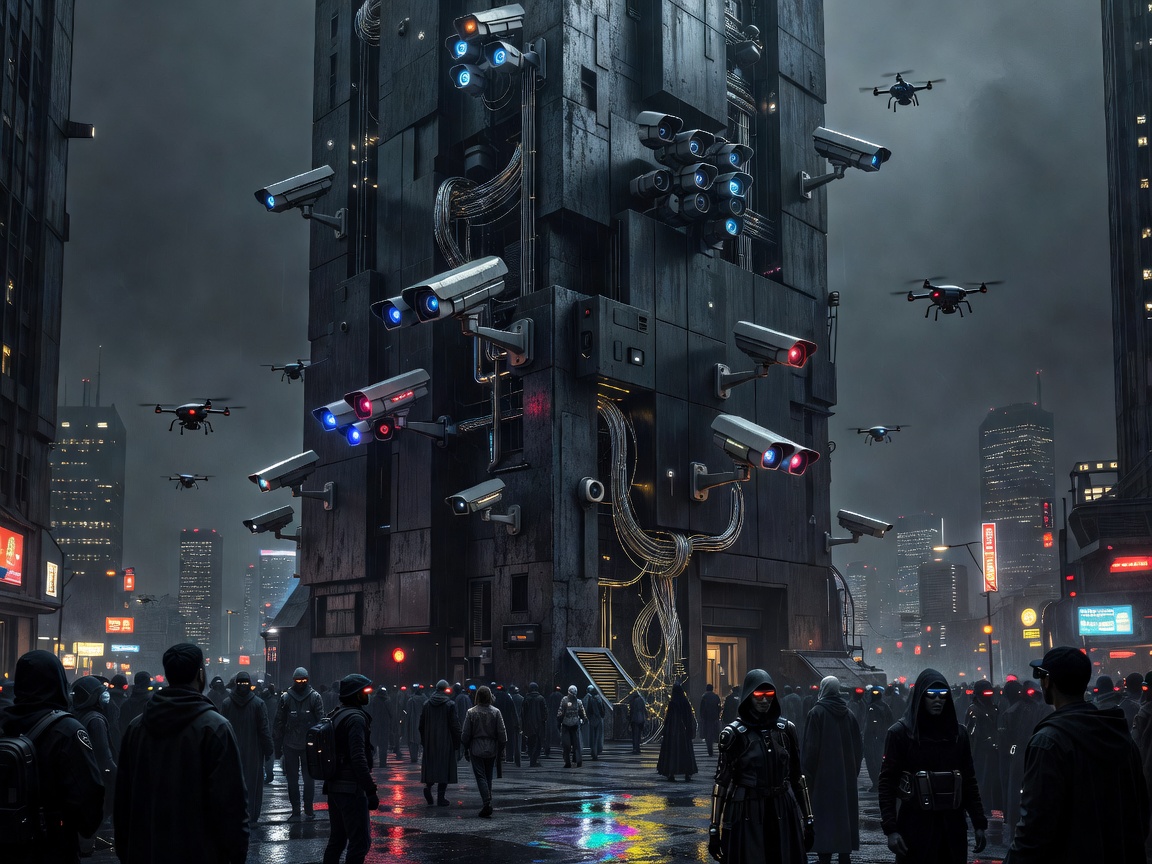
Corporations as weather systems
In cyberpunk, corporations are rarely just employers. They behave like weather: surrounding the city, setting conditions, owning infrastructure, shaping medicine, entertainment, security, housing, transport and identity. The corporate tower is the obvious image, but the deeper image is dependency. Characters may hate the company and still need its clinic, its network, its food chain, its police contract or its proprietary implant maintenance.
This is why the genre often treats state power as weakened, merged or outsourced. The exact arrangement changes by story, but the effect is familiar: accountability dissolves behind contracts, subsidiaries, private guards and technical systems. A person can be denied access without knowing who made the decision. A neighbourhood can be redesigned by remote capital. A body can be upgraded under terms it cannot escape. Cyberpunk makes bureaucracy glow, then shows the handcuffs inside it.
Artificial intelligence and the personhood fault line
Artificial intelligence in cyberpunk is not merely a clever machine. It is a boundary problem. If an artificial mind can want, remember, suffer, deceive, create or refuse, then the story must ask whether it is property, person, weapon, child, ghost or something that breaks those categories. Blade Runner’s replicants, Neuromancer’s AIs and Ghost in the Shell’s networked consciousness all orbit this fault line from different angles.
The most interesting AI stories avoid a simple monster shape. Fear remains, but it is braided with exploitation. Who built the intelligence? What constraints were placed on it? Who profits from its labour? What happens when a mind designed as a tool begins to understand the cage? Cyberpunk can make an artificial intelligence terrifying, sympathetic and politically charged at the same time because the genre already doubts the innocence of ownership.
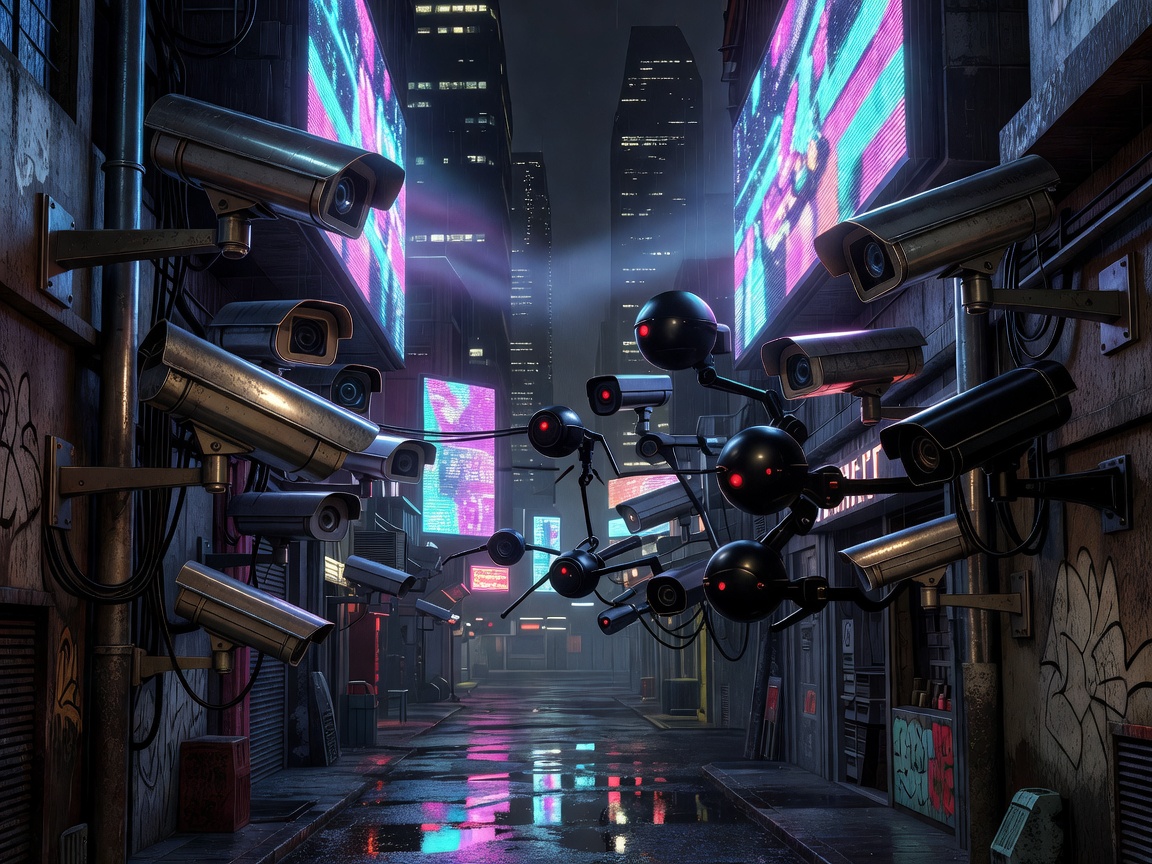
Surveillance: the city that looks back
Cameras, scanners, biometric gates, drones, databases and predictive systems fill cyberpunk because they turn public life into readable material. The watched city is not only safer or more dangerous; it is less private, less ambiguous, less forgiving. Movement becomes data. Purchases become data. Faces become data. A mistake becomes a permanent trace. The genre’s rain and glare often make this visible, as if every surface has become a lens.
Surveillance also changes rebellion. A street protest in an unwatched square has a different shape from resistance under total logging. Cyberpunk rebels therefore use masks, aliases, dead drops, encrypted channels, hacked cameras, decoys and physical meetings in forgotten spaces. The romance of the outlaw remains, but the practical mood is colder. To resist, characters must understand the system well enough to survive inside its gaze.
The body as contested territory
Cyberpunk loves modified bodies because the body is where abstract power becomes intimate. An implant can restore, enhance, mark, addict, indebt, monitor or separate. Cosmetic alteration can be self-expression or market pressure. A replacement limb can mean freedom in one scene and maintenance dependency in another. The genre’s familiar chrome is never neutral for long. It asks whether the body belongs to the person living in it or to the terms attached to its hardware.
This theme also opens questions of disability, labour and identity, though different works handle them with very different care. A thoughtful cyberpunk story does not treat augmentation as a simple ladder from weakness to strength. It asks who gains access, who is coerced, who is excluded, and what counts as a “normal” body once modification becomes socially and economically loaded.
Rebellion without purity
Cyberpunk rebellion is usually compromised. The hacker uses corporate tools. The courier sells data to survive. The mercenary takes a job from one bad actor to injure another. The journalist, detective or technician may expose a truth through systems that also exploit them. This impurity is not a flaw in the genre. It is the point. Clean resistance is difficult when the pipes, screens, clinics and roads all belong to the thing being resisted.
That is why small acts matter: leaking a file, hiding a person, breaking a camera, preserving a memory, refusing a forced upgrade, building a community network, telling a forbidden story. Cyberpunk often stages spectacular raids, but its deeper rebellion is the refusal to let a system define all possible life. Under the neon, the genre keeps asking a human question: what remains ours when everything has a user agreement?